Oklahoma City Blue Devils
D.C. Minner Lifetime Achievement Award
The early Jazz tradition in Oklahoma was more closely associated with the blues tradition than in many other places. The Territorial Bands played both jazz and blues. They traveled a 5 state area. Texas, Kansas, Arkansas, Missouri, and Oklahoma. One group was renowned for being the best of these many musicians. This was the Oklahoma City Blue Devils.
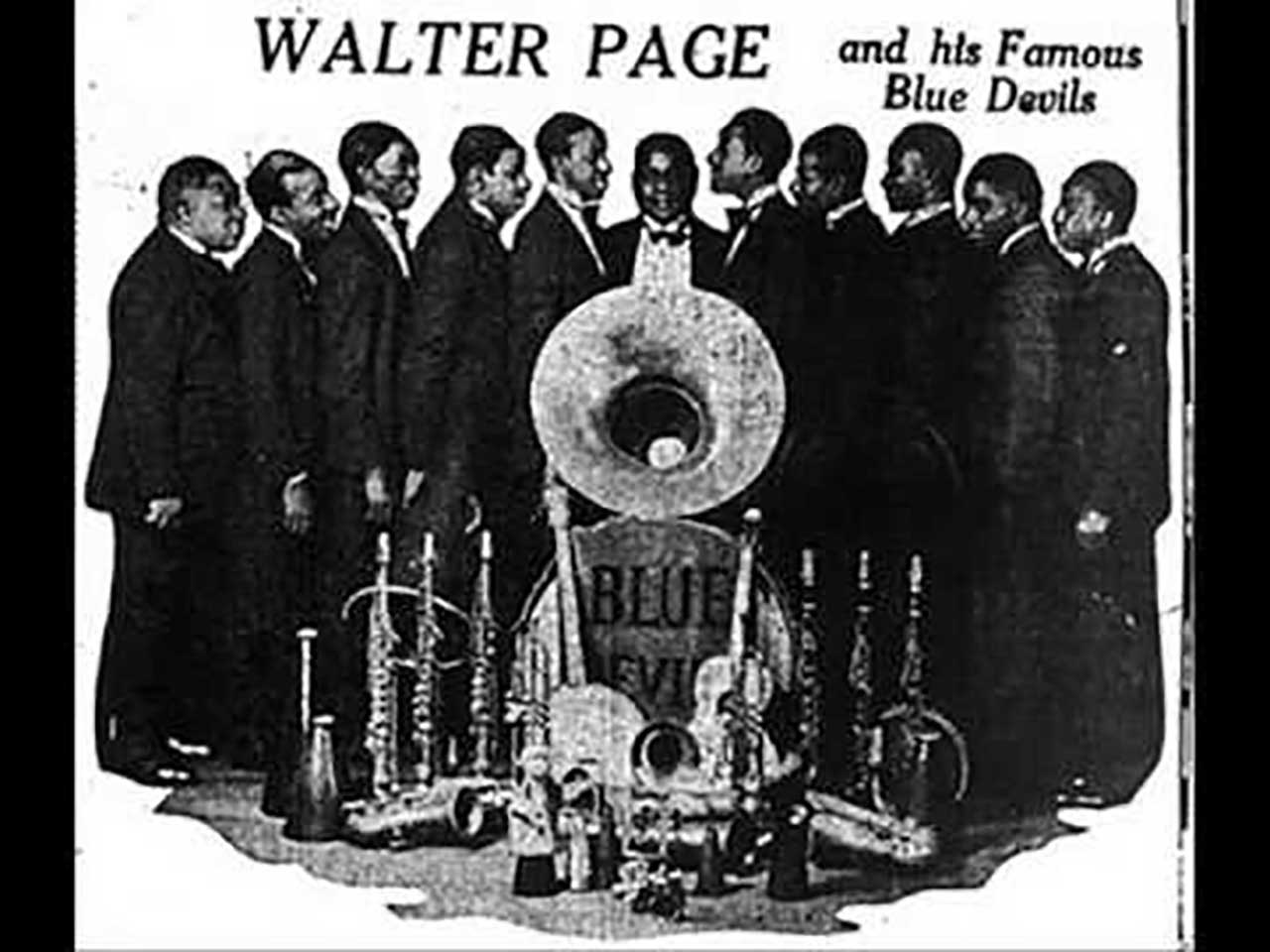
The Oklahoma City Blue Devils were a territorial band with a legendary reputation among musicians in the Southwest. Starting in 1923 accompanying Billy King’s road show, “Moonshine,” at the Aldridge Theatre in Oklahoma City, they also performed for white and African American audiences from Texas to the Dakotas until stranded in Bluefield, West Virginia. The Blue Devils were a “commonwealth” band, lacking a leader, and members voted democratically on every issue.
Early bandsmen included bassist Walter Page, pianist Willie Lewis, trombonist Ermal Coleman, and drummer Edward McNeil, and through the years singer Jimmy Rushing, saxophonist Henry “Buster” Smith, cornetist Oran “Hot Lips” Page, tromboner/guitarist/composter/arranger Eddie Durham, pianist William “Count” Basie, and Lester “Pres” Young. Bandsmen often taught lesser-known musicians before they joined the band.
The Blue Devils recorded only once, in 1929, cutting two records, “Blue Devil Blues” and “Squabblin’.” They were a rival of the Bennie Moten band from Kansas City, but the two never competed against one another in the famous “battle of the bands” as some musicians claimed. Several Blue Devils, Durham, Rushing, Basie, and Hot Lips Page among them, joined Moten’s orchestra, making the classic 1932 recordings including “Toby” and “Lafayette,” considered to be the earliest examples of big band swing.
By the mid-1930s the Blue Devils stayed in Kansas City performing in small bands and variously with bandleaders Moten and Basie. Pianist Eddie Christian led a new version of the Devils in 1935, but it was short-lived. When Basie formed his Reno Club combo in that city in 1935, his motto was to “get some Blue Devils.” The band was in his opinion the finest performers he ever heard.Lester Young, Walter Page, and Jimmy Rushing were stalwarts in the orchestra, and Durham wrote many of their hits with Rushing and Basie, whose orchestra went through several versions over five decades. Sources: Douglas Henry Daniels, One O’clock Jump: The Unforgettable History of the Oklahoma City Blue Devils (Boston: Beacon Press, 2005)
From the online Encyclopedia of OK History and Culture
The Oklahoma City Blue Devils began ca. 1923-24 in Kansas City as Billy King’s Road Show, a traveling vaudeville troupe. While trombonist Ermir “Bucket” Coleman had nominal control of the band, Walter Page masterminded the musical arrangements. Page’s credentials included study in 1920s Kansas City with Major N. Clark Smith and Charles Watts, who were numbered among that town’s best instructors. When the Billy King Road Show disbanded in1925 in Oklahoma City, Page renamed the group; some say it became “Walter Page’s Original Blue Devils,” but others contend it was the “Oklahoma City Blue Devils.” Once the Blue Devils were reorganized in Oklahoma City, Page persuaded a group of Oklahoma City businessmen to back the venture. The backing consisted of a little cash, a set of uniforms, a supply of meal tickets good at a restaurant owned by one of the sponsors, and the donation of a large hotel room (at the Littlepage Hotel in the “Deep Deuce” district, or Northeast Second Street).
From 1925 to 1933 they were among the finest bands in the region. The Blue Devils worked out of Oklahoma City’s Ritz Ballroom in the winter months, playing there and also at venues in other Oklahoma towns. The fall and spring tour took the band to ballrooms scattered over a wide area that included Omaha, Houston, El Paso, and Little Rock. They also played dates in states further west and north.
Early members of the Blue Devils included Oran “Hot Lips” Page, Jimmy Lu Grand, Harry Youngblood, James Simpson (trumpets); Ermir Coleman, Eddie Durham, Druie Bess, and Dan Minor (trombones); Reuben Roddy, Ted Manning, Theodore Ross, and Buster Smith (reeds); Willie Lewis and Turk Thomas (piano); Reuben Lynch (guitar); Edward McNeil and Alvin Burroughs (drums); Walter Page (bass, tuba, and baritone saxophone); and Ernie Williams (vocals). Four native Oklahomans at one time or another sat in with the Blue Devils, including Abe Bolar (bass), Lemuel C. Johnson (clarinet/tenor saxophone), and Jimmy Rushing (vocals) from Oklahoma City, and Don Byas (tenor/alto saxophone) from Muskogee. During their heyday the Blue Devils added such luminary jazz artists as Lester Young (tenor saxophone) and William, later known as “Count,” Basie (piano). The personnel included some of the finest musicians produced in two decades of jazz in the Southwest and Midwest. Several former Blue Devils, including “Lips” Page, Jimmy Rushing, Eddie Durham, and Walter Page, joined other soon-to-be legendary bands, including those of Bennie Moten and Count Basie. In 1929 in Kansas City the Blue Devils held their first and only recording session, on Vocalion 1463. The Blue Devils band was inducted into the Oklahoma Music Hall of Fame in 2000.
Count Basie –think Kansas City Blues– produced some of the most blues driven jazz ever created with these musicians from the Oklahoma – the Oklahoma City Blue Devils.