

Selby and D.C. Minner in Blues in The Schools
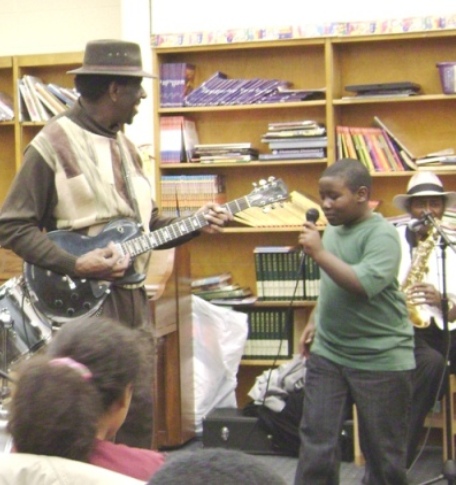
One finger and two finger chords for guitar beginners, taught by Selby Minner
USEFUL RESOURCES
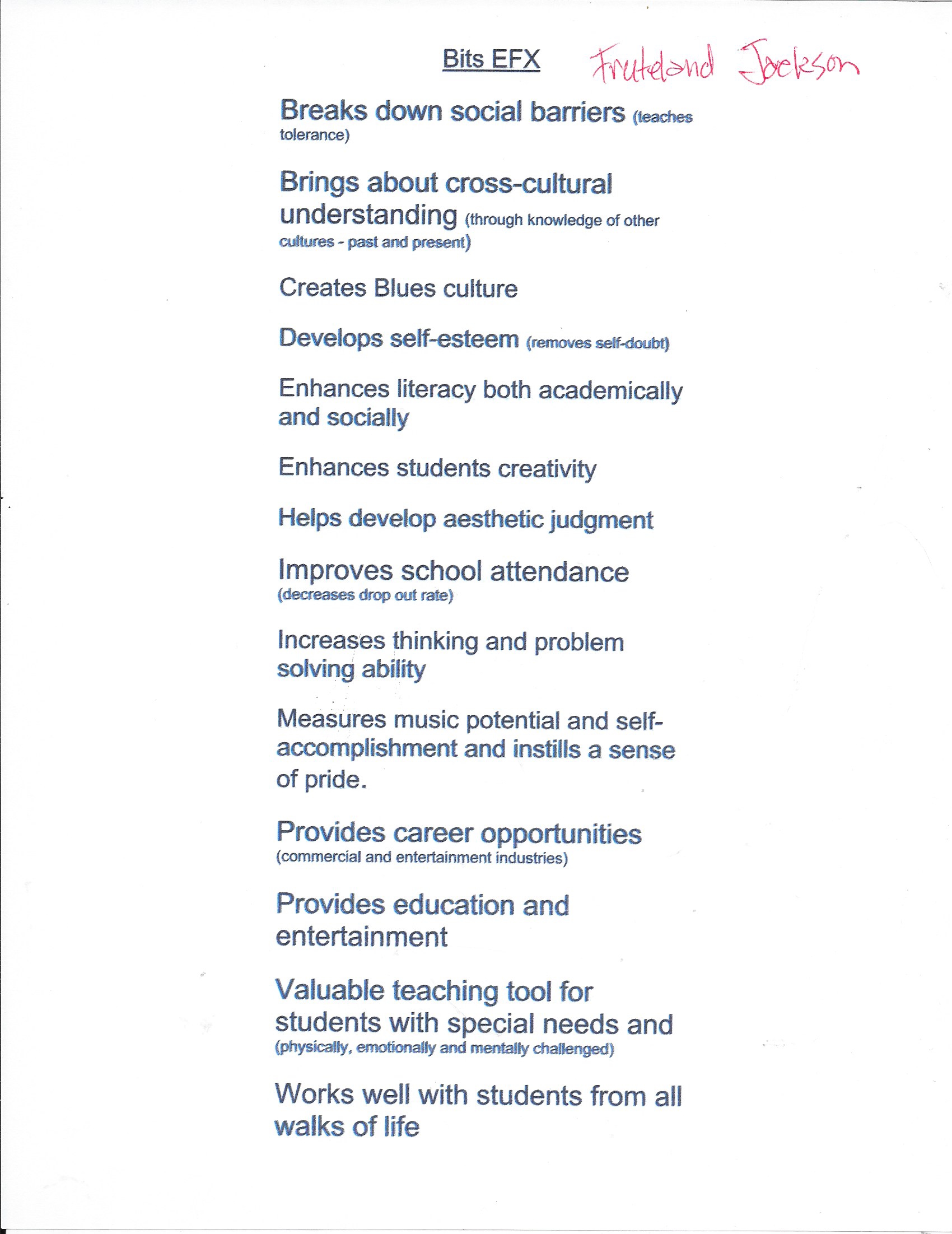
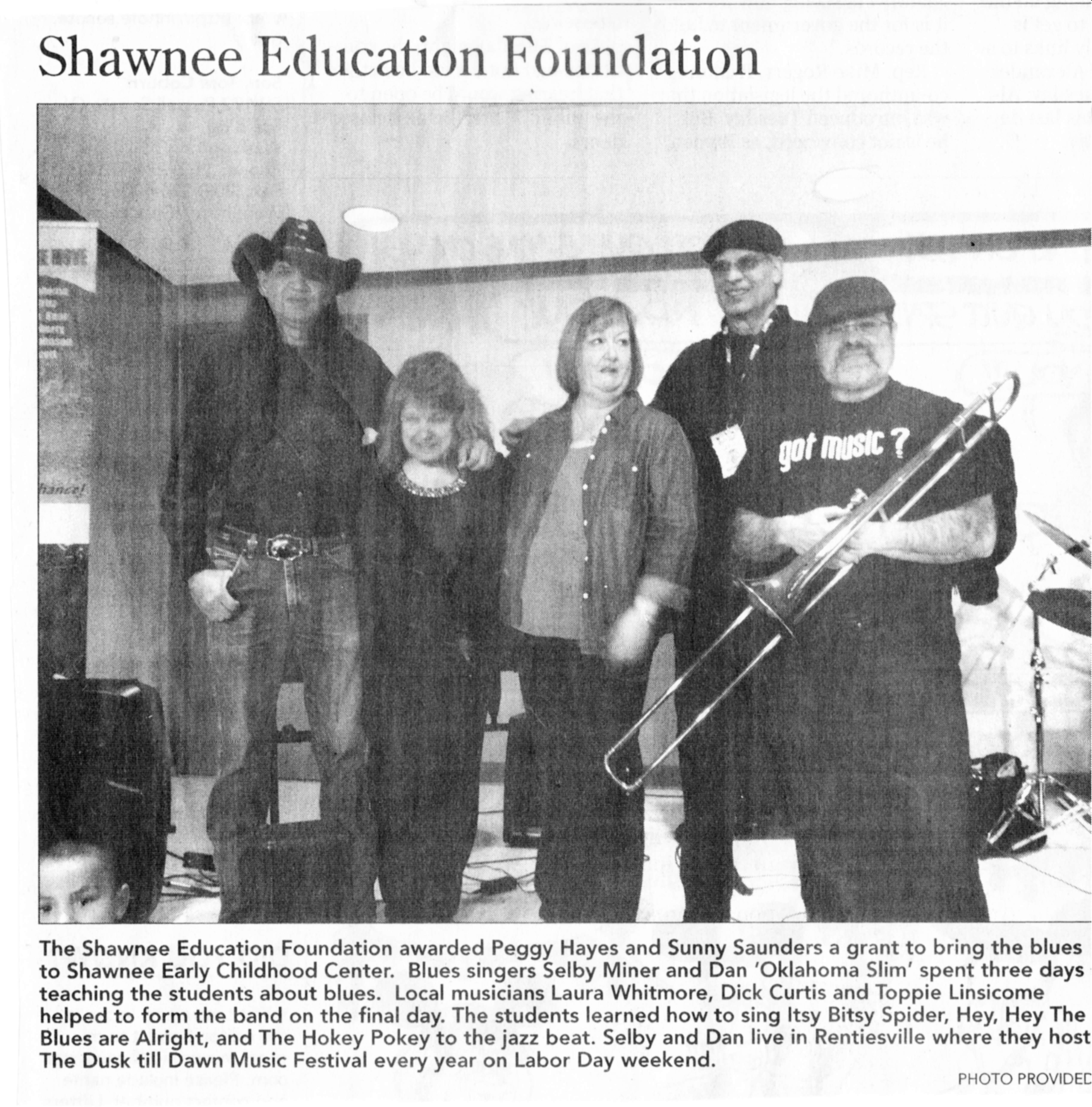
Selby Minner Education Images PDF
TeachRock.org – Steve Van Zandt E Street Band
Learn to Play / Blues in the Schools
Blues Foundation – Blues in the Schools
ARTIST IN RESIDENCE (EDUCATION) ROSTER
By Selby Minner
Settings: Schools: pre-k, elementary, middle, high, special ed, alternative ed
Community Sites: Art centers, libraries, parks, senior and recreation centers
Learning Goals:
We put on a performance last period of the residency and any students we see each day (target groups) get to be in the show. They dance or sing or play percussion. Skills we develop include:
- Confidence from performing in front of your peers: transferable from music to all of life
- Working together as a group and rehearsal skills
- Guitarists bring their guitar into school and learn a basic blues progression
- The disciplines involved in creating music ? counting time and memorizing lyrics, expressiveness, improvisation and more
- Decision making ? we work from a sheet of 50 age-appropriate songs, they vote on song choices, etc.
- Performance skills: using a microphone, projection, appropriate attire, improvising musically and in life
Selby Bio, with an eye to education:
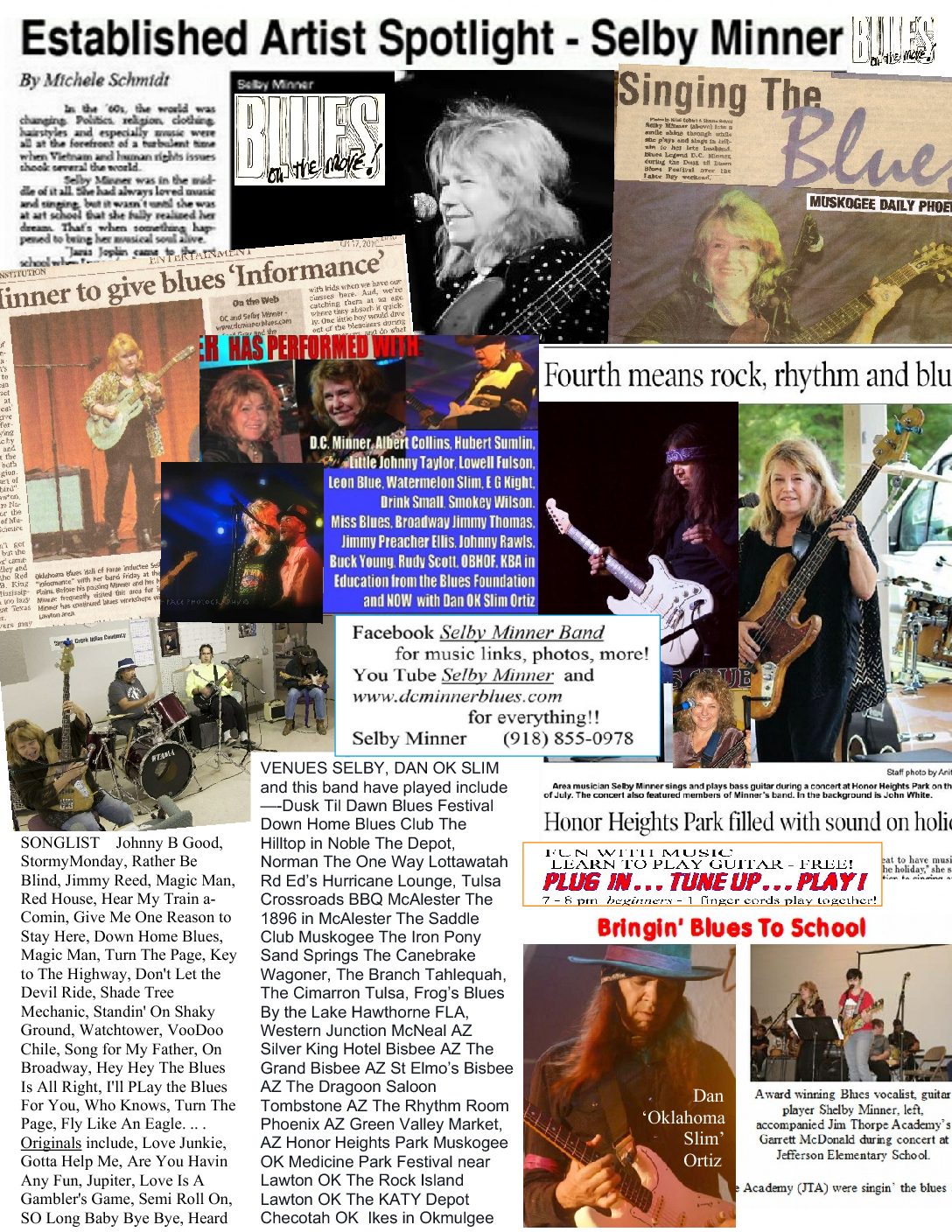
Selby Minner is an inductee in the Oklahoma Blues hall of Fame. She is a life time student of the music having been the bassist and singer with OK blues legend D.C. Minner for 31 years. She has performed with Little Johnny Taylor, E.G. Kight, Albert Collins, Hubert Sumlin, Tony Mathews and many more. She loves teaching and the kids she teaches love the electric guitar. She currently has Dan Ortiz on lead, an exciting classic rock blues guitarist.
Together with D.C., Selby won an international “Keeping the Blues Alive Award” in Education and has been featured in Living Blues Magazine, Black Entertainment Television and on the Oprah Winfrey Show. The pair performed across the nation, overseas and at home in Rentiesville. The couple’s invigorating residencies incorporated numerous curriculum areas including performance, math and history. Since the passing of D. C., Selby brings in another musician all week and adds the drummer on the day of performance so that the students will be able to sing, dance or play percussion (their choice) in a true band performance. They will also be able to trace Rock and Roll music of today back to its Blues origin.
The National Blues Foundation (they awarded Selby the KBA in Education, along with D.C. in 1999).
What Types of Programs Are Available?
The programs performers offer are the following:
- A one hour school assembly
- An all day workshop that either moves from class to class or remains in the same classroom all day.
- Artist in Residency programs that last from a week to a full month. These usually culminate in an evening performance or performance at a where the students actually get to BE IN THE BAND!
Where Do I Look to Fund These Programs?
- Funding such workshops requires a creative search of all the monetary options available.
- Teachers can apply for local Arts Council grants.
- There is also PTA money available at every school for the enrichment of the school. School Improvement Councils put money aside for assembly programs and could be approached, especially during Black History month, to fund a school wide program.
- A local blues society or blues festival could help underwrite the cost.
- More costly Artist in Residency programs might need the corporate sponsorship of a local business.
- An evening concert in the community by the performer can perhaps be tied into grant money. Thus a small grant can be augmented by a full house show at night.
Can Blues in the Schools Work?
Remember how influential music is in the lives of children. At a time when there are budgetary cuts of arts programs across the country, Blues in the Schools can reach students in a way few other curriculums can.
What’s My Next Step?
The Blues Foundation has an extensive list of contacts. D.C. Minner and Selby started BITS in OK from the Memphis Blues Foundation Pages (the people who gave D.C. and Selby the Keeping Blues Alive Award in Education in 1999).
What I found out is that blues is more than music; it is the life story of what African-Americans endured in the South.
— A high school studentI have been taught something that cannot be measured by grades; I have been taught to listen to music. The magic I’ve found is that through the musician singing about the trials of his life, it manages to brighten up mine. The first time I felt that, I began to understand why the blues came about.
— A high school studentResearch has proven that students exposed to the arts as part of their core curriculum test higher in every other subject and develop superior problem-solving skills.
— Association for the Advancement of Arts Education
What Blues in the Schools Is:
The most effective BITS programs utilize a classroom curriculum that affects many students and disciplines. A comprehensive curriculum of one week to a month in length can address the main educational issues of the next century, inter discipline and diversity.
How Can Blues in the Schools Fit Various Subjects?
Subjects like Music, Art, English, and Social Studies are natural fits, while creative teachers can individually figure ways to tie Math, Science and Tech Ed to a BITS unit.
Just a simple activity like designing a CD package enlists Art, English, and Music disciplines. When students plan out the touring itinerary for a band, they will utilize Math, Geography, and Language Arts skills in their planning of a month on the road.
At the high school level, the in-depth study of the sharecropping system in the Mississippi Delta combines English, Social Studies, and Music to deliver a very crucial understanding of the relationship between these social and cultural factors in the birth of the blues.
Why Blues in the Schools?
In the early 20th Century, W.E.B. Dubois wrote, “The problem of the 20th Century is the problem of the color line.” Through the study of blues traditions in any curriculum, educators can address educational issues like the color line, diversity, multi-culturalism, and interdisciplinary studies in a way that engages all aged students.
At a time when Dubois’ words still echo, an understanding of this truly original American music form allows students to appreciate this and other contributions of African-Americans to the world. The study of the blues is the study of the culture that produced this music. This cultural study is an investment in the human spirit
Studying the blues can give students deeper understanding of the rural and urban African-American culture.
With the exception of Native American music forms, the blues is the first pure American music form to have originated in this country. Coming from the oral traditions of folk music, the blues is the foundation for all other popular music forms students listen to today.
Just as important as understanding the evolution of the musical structure of the blues is understanding the ways blues music expressed individual emotions.
Students can be shown the essential part these rural lyrics played in the African-American oral traditions. Lacking an educational system, these early country blues men and women created beautiful poetry that responded to the conditions of their world. Sometimes the lyrics expressed the anger they could not speak. Other times, they painted a vivid picture of African-American life in those fields.
At the same time, the music incorporated danceable rhythms and so called “blue notes” that could assuage the day’s Jim Crow encounters.
Music reflects the feelings of the times. Through the blues, student listeners can feel what happened in those times and know to apply it to today.
From American Psychological Society
New Research Provides the First Solid Evidence that the Study of Music Promotes Intellectual Development
The idea that studying music improves the intellect is not a new one, but at last there is incontrovertible evidence from a study conducted out of the University of Toronto.
The study, led by Dr. E. Glenn Schellenberg, examined the effect of extra-curricular activities on the intellectual and social development of six-year-old children. A group of 144 children were recruited through an ad in a local newspaper and assigned randomly to one of four activities: keyboard lessons, voice lessons, drama lessons, or no lessons. Two types of music lessons were offered in order to be able to generalize the results, while the groups receiving drama lessons or no lessons were considered control groups in order to test the effect of music lessons over other art lessons requiring similar skill sets and nothing at all. The activities were provided for one year.
The participating children were given IQ tests before and after the lessons. The results of this study revealed that increases in IQ from pre- to post-test were larger in the music groups than in the two others. Generally these increases occurred across IQ subtests, index scores, and academic achievement. Children in the drama group also exhibited improvements pre- to post-test, but in the area of adaptive social behavior, an area that did not change among children who received music lessons.
This study is published in the August issue of Psychological Science, a journal of the American Psychological Society.
E. Glenn Schellenberg is currently with the Department of Psychology at the University of Toronto at Mississauga. He can be reached via e-mail at g.schellenberg@utoronto.ca.
Psychological Science is ranked among the top 10 general psychology journals for impact by the Institute for Scientific Information. The American Psychological Society represents psychologists advocating science-based research in the public’s interest.








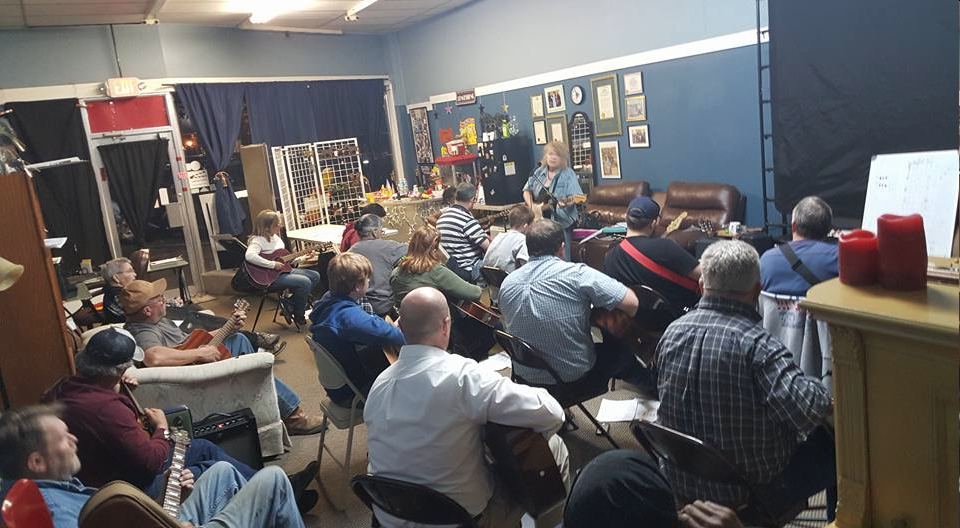
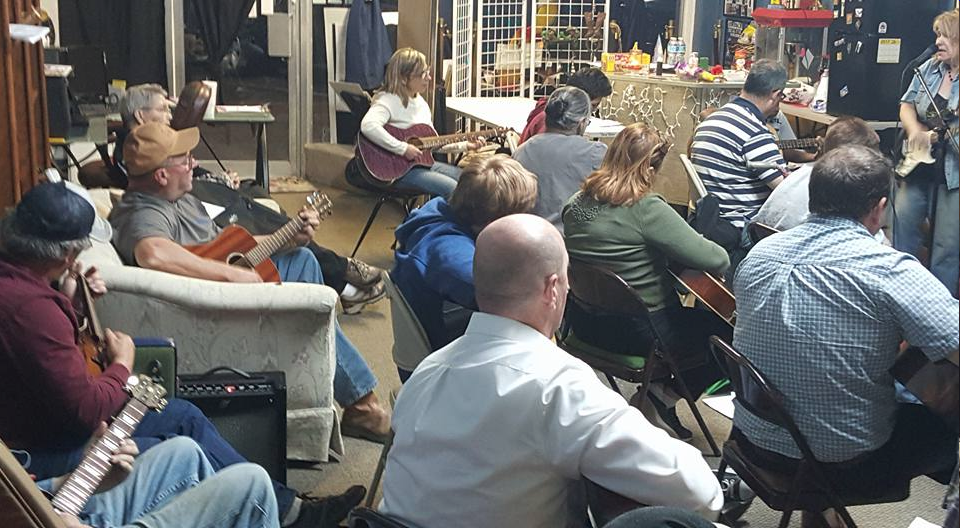
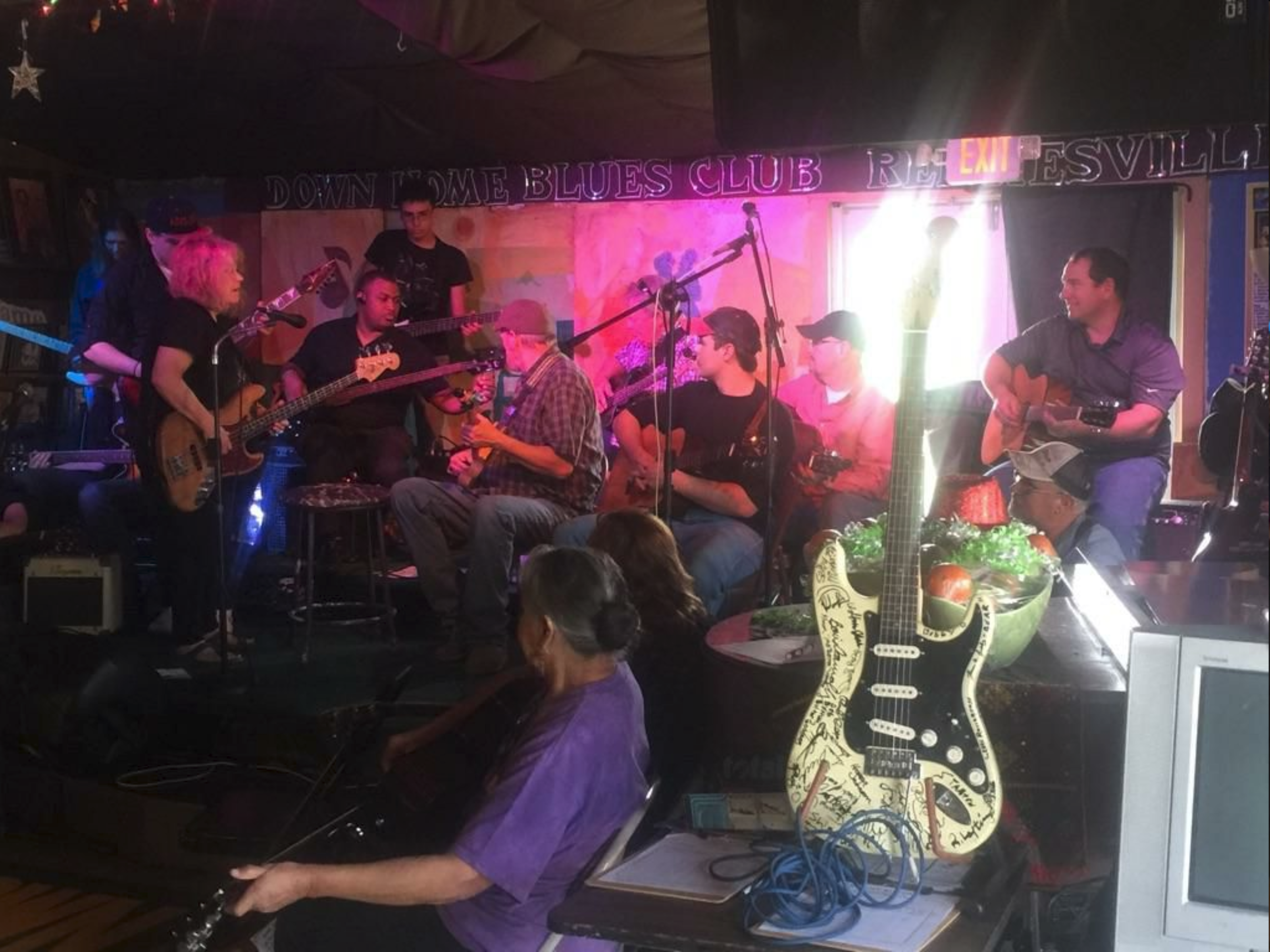
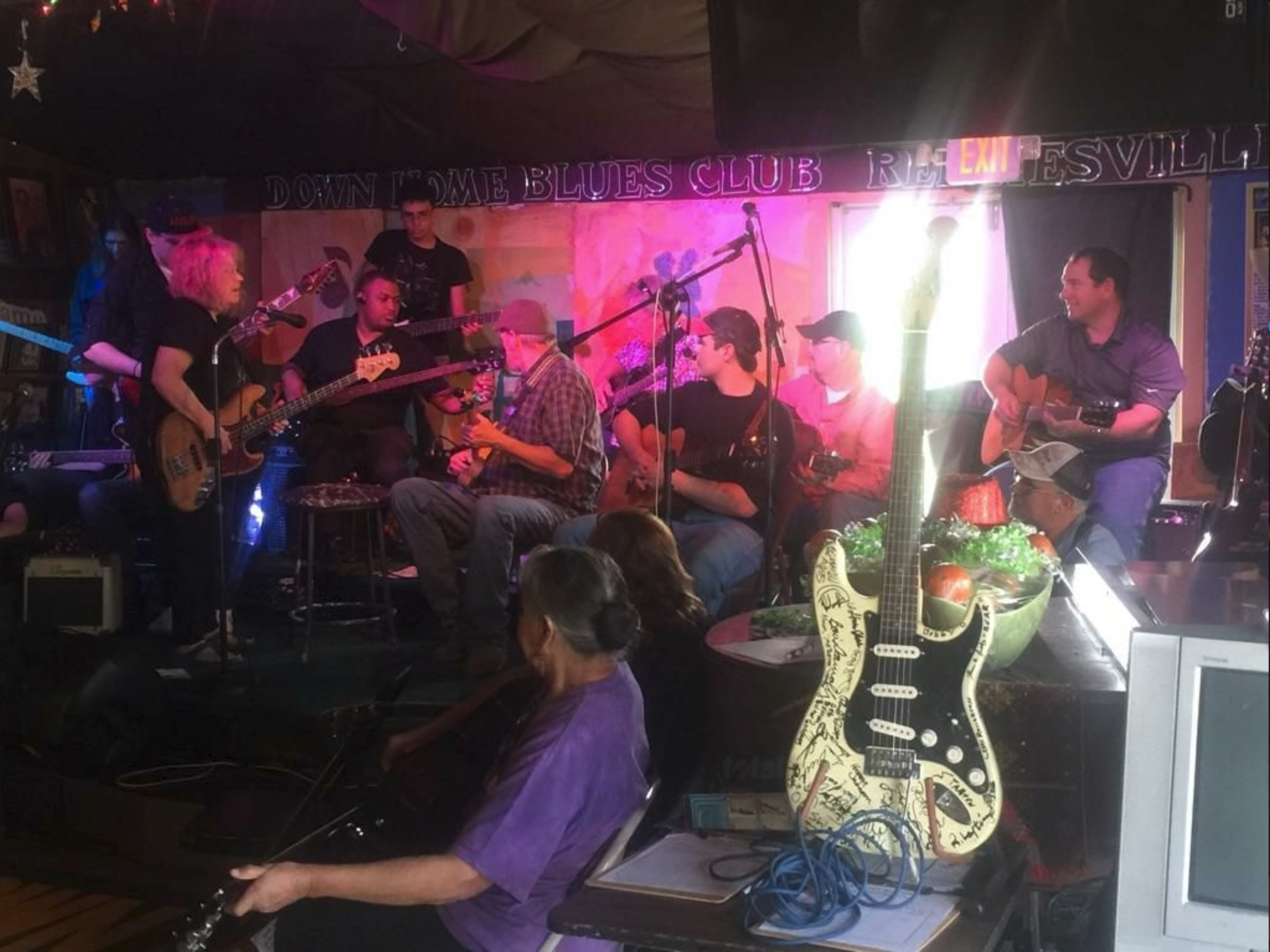

Testimonial from grandmother of a Selby Guitar Student:
“You are just amazing. Victor gets in the car so excited. When we got home he played his new notes and talked up a storm. Thank you. I’ll have him again in two weeks and if you are free he’d love another lesson.”
– Ann Chronister February 4, 2023
GIC jam brings local musicians together
Muscogee Nation News, Sterling Cosper/Editor

Photo by: Sterling Cosper/Editor
(Left to right) Selby Minner, Jack Anquoe Jr., Paul ‘Crazy P’ Anquoe and Dan ‘Oklahoma Slim’ Ortiz at the Glenpool Creek Indian Community Center Nov. 26 during one of several blues jam sessions held at the GIC Center.
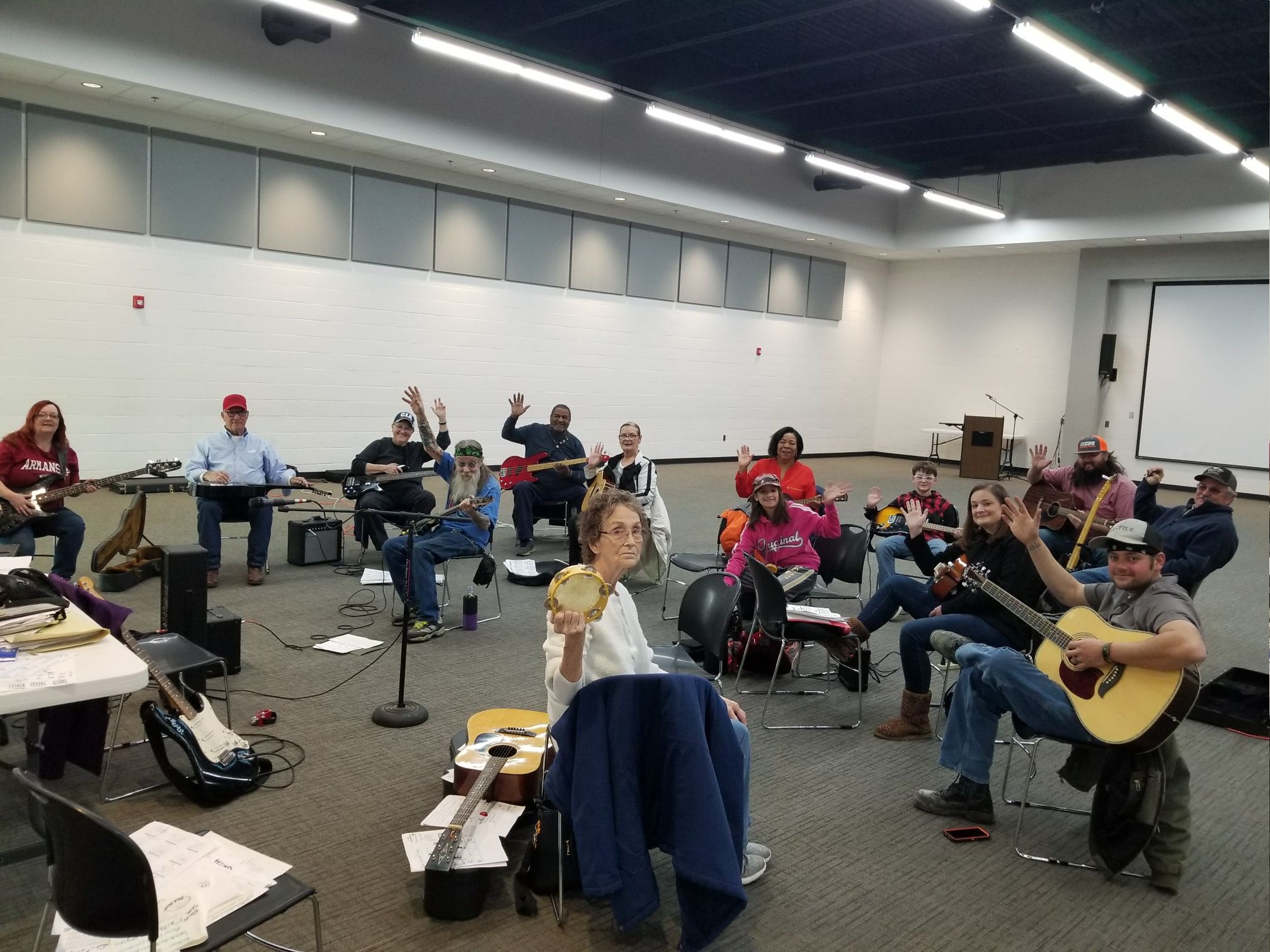
GLENPOOL, Okla. — Blues musician Selby Minner tunes up beginner Cherie Haney on bass, while three guitarists play around each other Nov. 26 at the beginning of a blues jam session and workshop at the Glenpool Creek Indian Community Center. “Ok, what key are we doing that in? A, that’ll work,” Minner said. Like a good bassist, Minner laid the foundation and the first song of the night came together, ‘Johnny B. Goode.’ GIC member and facilitator of the workshop Joy Harjo was introduced to Minner about two years ago. “She wanted to play the blues,” Minner said. “I started giving her a few bass lessons and she decided that she would like me to do a workshop and jam session there.” Harjo recently returned to Oklahoma after leaving years ago to attend the Institute of American Indian Art. “When I came back, it was important to me to work in the community with art,” Harjo said. To meet this goal, Harjo initially presented a proposal to the Muscogee (Creek) Nation National Council for the formation of a Mvskoke Nation Arts Council. The Council voted down the legislation during the March regular session. “It was difficult but I found that there was another way, so I decided to go at it via the community,” Harjo said. Harjo explained why Minner was chosen as the instructor for the GIC jam.“She is very good at working with people who have played for along time, as well as beginners,” Harjo said. This was demonstrated through her work with beginner bassist Haney who played Nov. 30 during a live show at GIC with the jam session group.“She held it down,” Minner said. Minner also provided feedback to Muscogee (Creek) guitarist Paul ‘Crazy P’ Anquoe who had previously played with his father Jack Anquoe Jr. on the world famous Beale Street blues strip, in Memphis, Tenn. “That’s why he’s not use to sharing the spotlight and likes to play really loud… His dad wants him to get more in contact with playing with other people,” Minner said. Oklahoma Blues Hall of Fame inductees, Selby Minner and her late husband D.C. Minner were also recipients of the Keeping Blues Alive Award for education. “With all the encouragement and insight I gained from working with a master, that’s my job; to try and keep this music alive and move it forward to the younger generation,” Minner said. Minner completed an unpublished book called ‘The Band Guide’ based on what she learned from her late husband about fronting a musical act. “He had a grassroots understanding of it that had never been written down. It is an unwritten culture just like your culture,” Minner said. She further tied the blues culture to Native culture. “What I’ve learned in all these years is the respect Native Americans have in tradition carries over when they start playing the blues,” Minner said. “They take the time to learn the music a little more thoroughly and learn the different patterns and roots of the music.” Harjo emphasized the importance of art in her own life and hopes to continue to share and emphasize this with her community. “It saved my life and kind of helped give me direction… it is important that art is part of education as well as athletics,” Harjo said. The first round of jam sessions ran from September to October, however Harjo and Minner are looking to start up again in late January or early February 2014. “I love teaching and helping people make their dreams come true. If I can do that, then I can make my dreams come true,” Minner said. Harjo hopes to start other workshops at GIC involving writing and pottery. For more information about upcoming GIC events, keep and eye on the ‘Muscogee Nation News’ community calendar on the last page of each edition.
WHY BLUES IN THE SCHOOLS:
The Blues Foundation on the Blues in the Schools (BITS) with D.C. and Selby

The Oklahoma State Arts Council
has sponsored many Blues in the Schools
Residencies and assembly programs!
My goal in getting music to the kids was very simple, and I could not have accomplished this without the help of Selby Minner. Her experience in putting music within the reach of young and old was pivotal in reaching my goal.
My kids began taking guitar lessons from Selby at the library in Muskogee in the spring of 2010. As anyone who has teens at home knows, when they are bored, a disagreement is just around the corner. The thing that became apparent to me shortly after my kids started lessons was, when they became bored, they still argued, but sometimes they played music together. This became more and more frequent, to my delight!
As my son and daughter began to discover self-expression through music, I began to as well. We began writing songs together and playing music as a family, which has brought us closer, in more ways than I can begin to explain. This is what I wanted to share with others.
I began telling everyone that would listen about the free lessons. Then, without warning, the funding was pulled for “Plug In, Tune Up and Play.” And like a lot of people, I didn’t do anything at first. Then I told Selby that I’d try to raise the money myself. As someone who had never in their life tried to do anything like this, I had no clue. I wasn’t even sure if I would be able to do this. I thought about the kids, the loss of income for Selby, and the loss of a great program, and I realized there was only one thing to do, and that was to move forward with securing funding for the program.
I jumped into the unknown. With Selby’s guidance and my optimism, in a town of 700 people, I raised enough money the first day of my efforts to pay for two months of lessons. Over the next week, I raised enough money to provide three additional weeks of lessons. As well as the monetary donations, two guitars were donated which were placed with kids that didn’t have their own.
I have never felt that I understood what it meant to do for others like I do now. I have Selby Minner and her vision to thank for this. Selby has touched many lives, as she has touched my family’s. I will continue to help her keep the dream alive. I hope any potential sponsors will do the same.
Thank you,
George Anthony
whit9467@yahoo.com
(918) 773-7453